
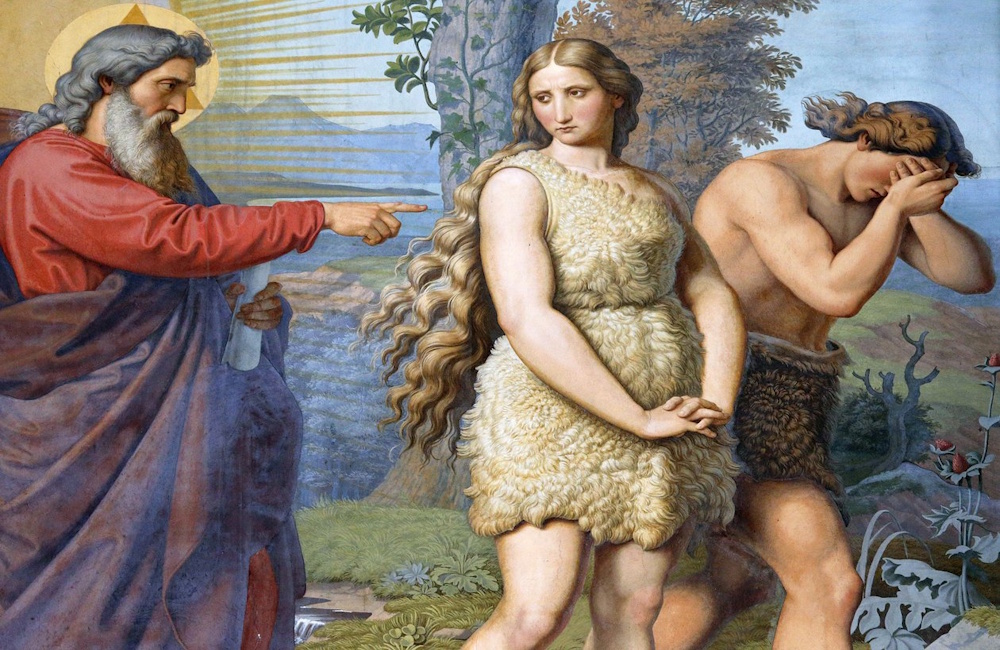
The expulsion of Adam and Eve from Paradise stands as a defining moment in both Christian and Islamic traditions, yet the two faiths interpret this event in fundamentally different ways. Christianity sees their disobedience as introducing Original Sin—a spiritual condition passed down through all generations that separates humanity from God and creates the need for redemption. Islam tells a different story. While Adam and his wife do disobey Allah’s command, they repent immediately and receive forgiveness. There is no inherited guilt, no universal curse. Instead, the episode demonstrates human weakness alongside divine mercy, establishing that each person bears responsibility for their own choices rather than inheriting the mistakes of their ancestors.
The Biblical Narrative
The Book of Genesis describes how God created Adam and Eve and placed them in the Garden of Eden, where they lived in perfect harmony with creation. They could eat from any tree except one—the Tree of the Knowledge of Good and Evil. God warned them that eating from it would bring death. The serpent, crafty and cunning, approached Eve with a challenge to God’s prohibition. It told her that eating the fruit wouldn’t kill them but would instead open their eyes and make them like God, knowing good and evil. Eve examined the tree and found its fruit appealing—good for food, beautiful to look at, and promising wisdom. She ate it and gave some to Adam, who was with her, and he ate as well.
The moment they ate, their eyes opened to their nakedness. They hastily covered themselves with fig leaves and hid when they heard God walking in the garden. When God confronted them, Adam blamed Eve for giving him the fruit, and Eve blamed the serpent for deceiving her. God pronounced judgment on all three. The serpent was cursed to crawl on its belly and eat dust, with lasting enmity established between it and humanity. Eve would experience increased pain in childbirth and would be subject to her husband’s authority. Adam faced a life of hard labor, with the ground itself cursed so that he would struggle to draw sustenance from it until he returned to the dust from which he came. God made clothing from animal skins for Adam and Eve before banishing them from Eden. He stationed cherubim with a flaming sword to guard the Tree of Life, preventing them from eating its fruit and living forever in their fallen condition.
This event introduced sin and death into human existence. Through Adam’s disobedience, all humanity inherited a sinful nature that separates people from God. Every person is born into this condition and faces both physical death and spiritual separation from their Creator. Christian theology teaches that only through Jesus Christ’s life, death, and resurrection can this broken relationship be restored. Salvation comes through faith in Christ and baptism, reconciling believers with God and offering them eternal life.
The Quranic Narrative
The Quran recounts the story of Adam and his wife (never explicitly named in the text) across several chapters, including Al-Baqarah, Al-A’raf, and Ta-Ha. Allah created them and placed them in Paradise with permission to enjoy everything except one particular tree, warning them not to approach it or they would wrong themselves. Iblis, who had been expelled from divine favor for refusing to bow to Adam, became their tempter. He whispered seductive promises of eternal life and an imperishable kingdom. They forgot Allah’s warning and ate from the tree. Realizing their error immediately, they covered themselves and turned to their Lord seeking forgiveness. The Quran emphasizes their repentance and Allah’s response. They acknowledged their wrongdoing and asked for mercy. Allah forgave them but decreed that they would descend to earth, where they and their descendants would live and be tested. He promised that guidance would come to humanity, and those who followed it would have nothing to fear.
Islam does not teach inherited sin. Adam and his wife’s mistake was their own, they took responsibility for it, and they were forgiven. Each person enters the world in a state of purity, free from any ancestral burden. The Quran makes this explicit: no one bears the sins of another. Everyone answers only for their own actions.
The Fundamental Differences
The biblical and Quranic accounts diverge not just in details but in their theological implications for understanding human nature, sin, and salvation. In Genesis, Eve is named and plays the central role in the temptation, speaking with the serpent and eating first before giving the fruit to Adam. Their act transformed the human condition fundamentally. Through Adam, sin and death entered the world, and every subsequent generation inherited this sinful nature. Christianity teaches that all people are born separated from God, living under sin’s penalty. This fallen state requires redemption that only Jesus Christ can provide. Through His sacrifice and resurrection, Christ bridges the gap between God and humanity, offering salvation and eternal life to those who believe in Him.
The Quran never names Adam’s wife and places no special blame on either partner. Both were deceived by Iblis equally, and both are addressed together throughout the account. After eating from the tree, they immediately acknowledged their error, repented, and received Allah’s forgiveness. Islam contains no doctrine of Original Sin. People are not born carrying Adam’s mistake. Each person comes into existence in a state of natural purity and remains fully responsible for their own choices. The descent from Paradise to earth was not punishment but part of Allah’s plan to establish humanity as His stewards on earth. Life here is a test, and those who follow divine guidance will succeed in the afterlife.
These differences reveal distinct theological foundations. Christianity understands the fall as explaining human sinfulness and the necessity of divine salvation through Christ. It addresses why humanity stands separated from God and why redemption is required. Islam sees the story as teaching about human weakness, the importance of repentance, and the nature of God’s mercy. It establishes personal accountability rather than inherited guilt, affirming that people can always turn back to God. Both traditions recount humanity’s first disobedience and subsequent departure from Paradise, but they draw opposite conclusions about what this means for human nature and salvation. Christianity traces sin to this original act and points to Christ as the solution. Islam treats the episode as a lesson about fallibility and forgiveness, maintaining that each person begins life innocent and answers only for their own deeds.