
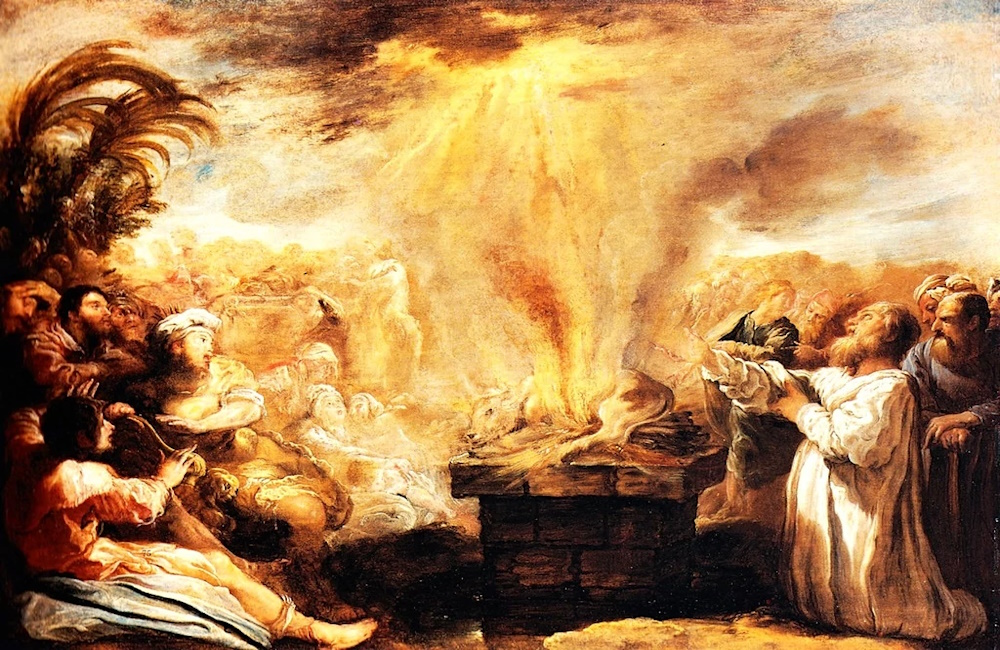
In Judaism, prophets are distinguished by their direct and personal interactions with God—encounters marked by an immediacy and intimacy that set them apart from mere religious teachers or philosophers. This direct communication is a hallmark of their prophetic role and validates their authority and messages in ways that cannot be replicated through secondhand transmission or intermediary figures. The authenticity of a prophet in the biblical tradition rests fundamentally on this unmediated access to the divine voice. Here’s how different Jewish prophets experienced their encounters with God:
Moses (Moshe): The Face-to-Face Encounter
Moses is considered the greatest of all Jewish prophets, largely due to his unique and direct communication with God. The Torah describes Moses’ interactions with God as being “face to face” (Deuteronomy 34:10). Notable encounters include the burning bush (Exodus 3:2-4) and receiving the Torah on Mount Sinai, where “The LORD would speak to Moses face to face, as one speaks to a friend” (Exodus 33:11). When Moses descended from these encounters, his face shone with such radiance that the Israelites could not look upon him (Exodus 34:29-35).
Samuel (Shmuel): The Voice Calling
Samuel’s prophetic calling came as a child through a direct, audible voice from God. While serving under high priest Eli, God called Samuel by name during the night. After initially thinking it was Eli, Samuel was instructed to respond: “Speak, LORD, for your servant is listening” (1 Samuel 3:4-10). Throughout his life, Samuel continued to receive direct revelation from God, serving as judge and prophet with authority derived from this unmediated access to the divine will.
Elijah (Eliyahu): The Divine Encounter on Mount Carmel
Elijah’s prophetic role was characterized by dramatic and direct interactions with God. On Mount Carmel, he challenged the prophets of Baal, and God sent fire from heaven to consume his sacrifice (1 Kings 18:38-39). Later, fleeing from Jezebel, Elijah encountered God in a “gentle whisper” on Mount Horeb (1 Kings 19:12). Elijah’s relationship with the divine was so profound that he was ultimately taken directly into heaven without experiencing death (2 Kings 2:11).
Isaiah (Yeshayahu): The Visionary Revelation
Isaiah’s prophetic experiences were marked by vivid and direct visions of God. In his famous temple vision (Isaiah 6), Isaiah saw the Lord seated on a high throne with seraphim attending Him. Overwhelmed by divine holiness, he cried out, “Woe to me! I am ruined!” (Isaiah 6:5). A seraph purified him with a coal from the altar, and Isaiah heard God’s voice asking, “Whom shall I send?” He responded directly: “Here am I. Send me!” (Isaiah 6:8).
Jeremiah (Yirmiyahu): Direct Instructions and Visions
Jeremiah’s prophetic role involved direct divine communication through visions and personal revelations. His call came when God declared, “Before I formed you in the womb I knew you” (Jeremiah 1:5). God touched Jeremiah’s mouth, saying “I have put my words in your mouth” (Jeremiah 1:9). Throughout his ministry, his prophecies began with “The word of the LORD came to me,” indicating direct divine communication. The intimacy of their relationship is evident in Jeremiah’s recorded complaints and arguments with God, demonstrating unmediated dialogue.
Jonah (Yonah): Direct Command and Reluctance
Jonah received a direct command from God to deliver a message to Nineveh: “The word of the LORD came to Jonah son of Amittai: ‘Go to the great city of Nineveh and preach against it'” (Jonah 1:1-2). After initially fleeing, Jonah was swallowed by a great fish and prayed directly to God. When released, “The word of the LORD came to Jonah a second time” (Jonah 3:1). Even Jonah’s complaint about God’s mercy was met with direct divine response through dialogue and object lessons.
Conclusion: The Authentication of Direct Divine Encounter
The direct experiences of Jewish prophets—through audible voices, dramatic visions, physical theophanies, and miraculous signs—highlight their profound and personal communication with God, affirming their roles as authentic messengers of divine will. Figures such as Moses, Samuel, Elijah, Isaiah, Jeremiah, and Jonah each had direct encounters with God, which established their credibility and authority as prophets. These were not second-hand reports or messages passed through intermediaries; they were immediate, personal experiences of the divine presence. The prophets saw God, heard His voice, spoke with Him, questioned Him, and received His responses directly. Their prophecies carried the weight of firsthand testimony—”Thus says the LORD” meant they had actually heard the Lord speak.
In stark contrast, Muhammad received his revelations through an intermediary, the angel Gabriel (Jibril), rather than direct communication with God. While Muslims regard the Quran as the literal word of God conveyed by Gabriel, the absence of direct interaction between Muhammad and God raises significant questions about the nature of his prophetic experience and its alignment with the biblical pattern of authentic prophecy. Muhammad never claimed to have seen God, never claimed to have heard God’s voice directly, never claimed to have stood in God’s presence as Moses did. Instead, all of his revelations came through an angelic being who identified himself as Gabriel.
In both Jewish and Christian traditions, it is acknowledged that the devil can masquerade as an angel of light (2 Corinthians 11:14), capable of deceiving even the sincere and devout through supernatural manifestations and false prophecies. However, it is explicitly understood that while Satan can impersonate angels, he is fundamentally incapable of impersonating God Himself—the divine essence, authority, and presence cannot be counterfeited by a created being. Given this understanding, Muhammad’s revelations—delivered by an angel who, from a critical biblical perspective, could be a deceptive force—are viewed by many Christians and Jews as being influenced by a false source rather than by the true God of Abraham, Isaac, and Jacob.
This perspective suggests that Muhammad’s teachings, rather than being divinely inspired by the God who revealed Himself to Moses face-to-face and to Isaiah in the temple, may have originated from a deceptive entity pretending to be Gabriel. The pattern is concerning: an angel appears claiming to bring divine revelation, yet the content of that revelation contradicts the previous revelations given directly by God to His prophets. The Quran denies the crucifixion of Jesus, contradicts the nature of God as revealed in Scripture, and presents a different path to salvation—all while claiming to come from the same God who spoke to Moses and the prophets. If this were truly the same God, why would He not speak directly to Muhammad as He did to His previous prophets? Why would He resort to an intermediary when He had always before spoken face-to-face with those He called?
The Biblical perspective maintains that true prophecy is marked by direct divine communication and alignment with established divine principles and previous revelation. God does not contradict Himself, nor does He establish patterns of direct communication only to abandon them in favor of indirect, mediated messages. Given that Muhammad’s teachings diverge fundamentally from biblical teachings and are transmitted through an intermediary rather than direct contact with God, this raises serious questions about their authenticity and alignment with traditional divine revelation. The lack of direct divine encounter—the very credential that authenticated every biblical prophet—is conspicuously absent from Muhammad’s experience.
This critical difference indicates that Muhammad’s teachings are not aligned with the direct, authoritative messages conveyed by the prophets of Judaism and Christianity. Where Moses spoke with God face-to-face, Muhammad received messages from an angel. Where Isaiah saw the Lord in His temple, Muhammad received recitations from a being claiming to be Gabriel. Where Jeremiah felt God’s touch on his mouth, Muhammad received no such direct contact with the divine. The pattern of biblical prophecy—immediate, personal, direct communion with God Himself—is entirely absent from Muhammad’s prophetic claims, suggesting that the source of his revelations was something other than the God who revealed Himself so directly and unmistakably to the prophets of Israel.