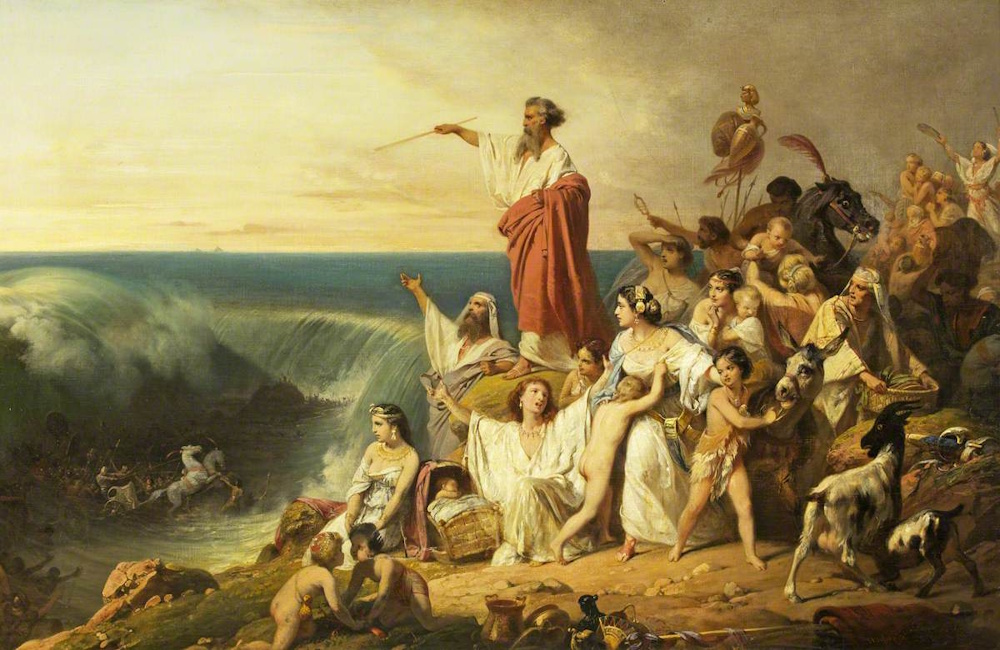
The crossing of the Red Sea is not just a story—it is a divine, historical miracle that forever changed the course of humanity. This was a real event, orchestrated by the hand of God, revealing His unmatched power and unwavering faithfulness to His people.
Enslaved in Egypt: God’s People Cry Out
For generations, the Israelites were enslaved under the harsh rule of Egypt. They cried out in suffering, and God heard their cries. He raised up Moses—not just as a leader, but as a vessel of His will—to confront Pharaoh and demand freedom for His chosen people. When Pharaoh refused, God struck Egypt with ten devastating plagues, each one a sign that no earthly king could stand against the Almighty. Finally, Pharaoh relented.
The Trap at the Red Sea
As the Israelites journeyed out of Egypt, they found themselves caught between Pharaoh’s armies and the waters of the Red Sea. Fear and despair began to spread—but Moses, led by unwavering trust in God, stood firm. He raised his staff, stretched out his hand, and the God of Heaven responded.
The Waters Parted by God’s Power
In a breathtaking miracle, the Red Sea split in two. Walls of water rose on both sides, and dry ground appeared beneath their feet. Every Israelite crossed safely under the protection of the Almighty. When Pharaoh’s army pursued them, God brought the waters crashing back, utterly destroying the oppressors. Not one soldier survived. This was not nature—it was divine judgment and deliverance.
Freedom by God’s Hand
This miracle marked the true liberation of God’s people. It was the moment they left slavery behind—not by their own strength, but by the outstretched arm of the Lord. This event is eternally remembered during Passover, celebrated as the moment God redeemed His people. For Christians, it points directly to Jesus—the greater deliverer—who rescues from the bondage of sin.
The account appears in the Book of Exodus with striking clarity, and the event is remembered throughout Scripture. The Psalms celebrate it as evidence of God’s power and faithfulness. The prophets invoke it as proof of God’s care for His covenant people. In the New Testament, the crossing is recalled as a foreshadowing of baptism and redemption. Across centuries of faith, this moment has stood as a defining demonstration of God’s ability to make a way where there is none.
Islamic tradition also honors this miracle. In the Quran, Moses is called upon to strike the sea with his staff, and the waters part to allow the believers to escape. Pharaoh and his forces are then overwhelmed by the returning waves. The shared recognition of this event across both Jewish and Islamic traditions underscores its significance in the broader narrative of monotheistic faith.
A Truth Affirmed by Faith
The parting of the Red Sea is not a metaphor. It is not a legend. It is a recorded miracle, affirmed by Scripture and by the Spirit of God. It is also mentioned in the Quran, where Moses is recognized as a prophet who obeyed God’s command. Attempts to explain it away with science only reveal how far the world has drifted from acknowledging the supernatural.
In modern times, various theories have emerged attempting to explain the Red Sea crossing through natural phenomena—unusual wind patterns, volcanic activity, or seismic events that might temporarily expose a land bridge. While such explanations may satisfy a skeptical mindset, they miss the essence of what the text describes. The miracle was not merely that a path appeared, but that it appeared at precisely the right moment, remained open long enough for an entire nation to cross, and closed at the exact instant needed to stop their pursuers.
The inclination to rationalize miracles reflects a broader cultural shift. In an age that privileges empirical evidence and material explanation, the supernatural is often dismissed as primitive or unenlightened. Yet this perspective assumes that the physical world is all there is. Faith does not require the abandonment of reason, but it does require the humility to recognize that reason has limits.
This miracle was given as a sign—a demonstration of God’s character and His commitment to those who trust Him. The Israelites who crossed that sea carried the memory forward, teaching it to their children as a reminder that the God who delivered them once could be trusted to deliver them again. That promise extends beyond one nation or one moment. It is a declaration that God acts on behalf of His people, that He hears their cries, and that He intervenes when all seems lost. The God who parted the sea still moves in power today, still makes ways through impossibility, and still calls His people to walk forward in faith. Truth stands: God delivered His people with His own hand—and He still delivers today.